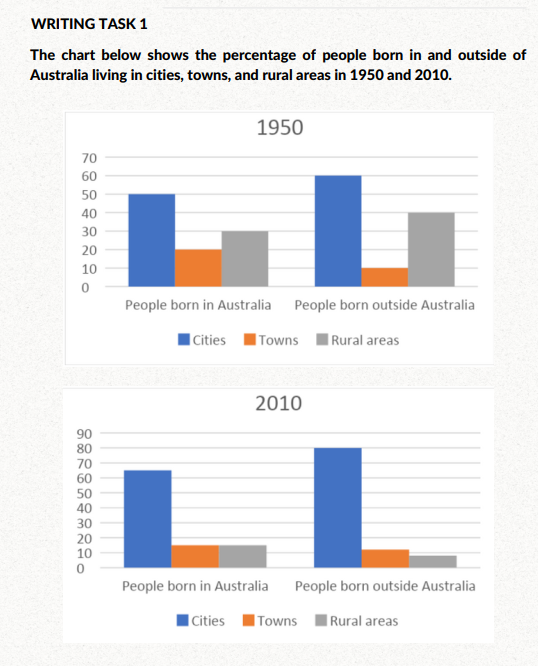
The bar charts illustrate the proportions of people born in Australia and those born overseas who resided in cities, towns, and rural areas in 1950 and 2010.
Overall, cities were the most popular place of residence for both groups across both years, and this dominance became even more pronounced by 2010. Meanwhile, the percentages living in towns and rural areas generally declined over the period.
In 1950, approximately 50% of Australian-born people lived in cities, while around 20% lived in towns and 30% in rural areas. For those born outside Australia, city living was even more common at roughly 60%, with only about 10% in towns and 40% in rural areas.
By 2010, there had been a notable shift towards urban living for both groups. The proportion of Australian-born residents in cities rose to about 65%, whereas the figures for towns and rural areas fell to approximately 15% and 18% respectively. A similar but more dramatic trend was observed among those born overseas, with nearly 80% living in cities, and only around 10% in towns and 8% in rural areas.
In summary, both populations showed a clear movement towards cities over the sixty-year period, though people born outside Australia consistently demonstrated a stronger preference for urban living than their Australian-born counterparts.
Rich countries often give money to poorer countries, but it does not solve poverty. Therefore, developed countries should give other types of help to poorer countries rather than financial aid. to what extent do you agree or disagree?
The proposition that wealthy nations should pivot away from financial assistance toward alternative forms of aid is a seductive critique of the failures of development policy. While I acknowledge that capital alone is a blunt instrument that has often failed to pierce the armor of systemic poverty, I maintain that discarding monetary aid entirely would be an act of ideological purity that ignores the desperate material realities of the developing world. A sophisticated strategy requires both the transfer of wealth and the transfer of wisdom.
The case for non-financial assistance is rooted in the principle of empowerment over dependency. Critics of monetary aid correctly identify that writing checks to corrupt or incompetent regimes often serves only to entrench the powerful while leaving the poor stagnant. In contrast, the export of human capital delivers lasting structural change. When wealthy nations dispatch engineers to design water systems or teachers to train educators, they are planting seeds that will bear fruit for generations. This approach builds the internal musculature of a nation rather than simply fattening it on a diet of foreign subsidies. The meteoric rise of Singapore and South Korea stands as a testament to the transformative power of knowledge transfer and trade access over mere charity. These nations did not wait for handouts. They seized the tools of modernity and built their own empires.
However, the demonization of financial aid is a luxury that the starving cannot afford. There are acute crises such as famines, pandemics, and natural disasters where the immediacy of cash is the only barrier between life and death. No amount of technical expertise can rebuild a city leveled by an earthquake without the cement and steel that money buys. Furthermore, many developing nations suffer from a fundamental absence of infrastructure that renders other forms of aid impotent. You cannot deploy a team of doctors to a region with no hospitals and you cannot educate a population that is too hungry to concentrate. In these contexts, financial investment is not a crutch but the very foundation upon which all other progress must be built. The failure of aid has not been in the giving of money but in the lack of leverage to ensure it reaches its intended target.
In conclusion, the debate between financial and non-financial aid is a false dichotomy. Wealthy nations must wield every tool in the arsenal simultaneously. They should inject capital to build the physical infrastructure of survival while simultaneously exploring the expertise and trade partnerships that foster independence. To choose one over the other is not just bad policy but a moral abdication.
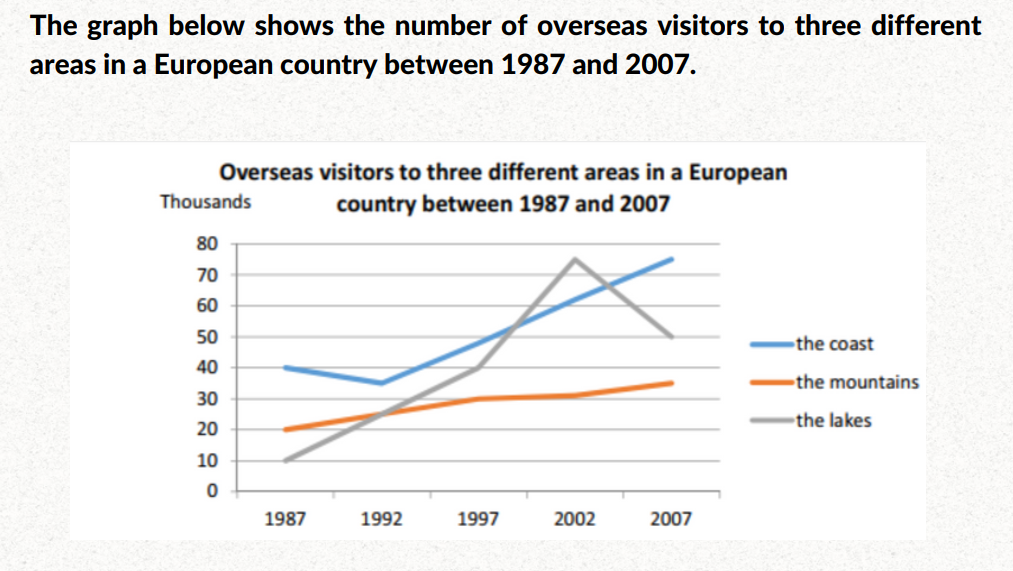
The line graph illustrates how many overseas tourists visited three different destinations — the coast, the mountains, and the lakes — in a European country over a twenty-year period from 1987 to 2007.
Overall, the coast experienced a steady rise in visitor numbers throughout the period, ultimately becoming the most popular destination by 2007. In contrast, visits to the lakes surged dramatically before declining sharply, while the mountains saw modest but consistent growth.
In 1987, the coast attracted the highest number of overseas visitors at approximately 40,000, followed by the mountains at around 20,000 and the lakes at just 10,000. Over the next five years, coastal visitor numbers dipped slightly to about 35,000 before recovering and climbing steadily to reach roughly 75,000 by 2007. This made it the most visited area by the end of the period.
Meanwhile, visitors to the mountains increased gradually from 20,000 in 1987 to approximately 30,000 in 1997, and this upward trend continued, reaching around 35,000 by 2007. The most striking trend, however, was seen in the lakes, which experienced a sharp rise from just 10,000 visitors in 1987 to a peak of roughly 75,000 in 2002, overtaking both other destinations. This was followed by an equally dramatic fall to approximately 35,000 in 2007.
In summary, while coastal tourism showed the most consistent growth and the mountains experienced gradual increases, the lakes witnessed the most volatile pattern, with a remarkable boom and subsequent decline over the two decades.